Water Extraction & Drying in Joplin, MO
Getting water out of a house sounds simple until you're the one standing in it with a wet vac, watching the tank fill up for the third time while the carpet still squishes. Real water extraction and structural drying is a different scale of job entirely — pumps that move hundreds of gallons quickly, air movers and dehumidifiers sized to the actual space, and moisture meters that confirm a structure is dry instead of just guessing based on how it looks.
Joplin Water Damage provides water extraction and drying for homes and businesses across Joplin and Jasper County, whether it's the whole job or the equipment-heavy piece of a larger cleanup. This is often the part of a water loss that decides whether the rest of the job stays small or grows into a demolition project, which is why it's worth getting right the first time instead of improvising.
What Extraction and Drying Actually Means
These are two different steps that people often lump together. Extraction is removing the water you can see and feel — standing water on a floor, saturated carpet and pad, water pooled in low spots. Drying is what happens after: pulling the moisture out of everything the water touched but didn't necessarily soak all the way through, including materials that look dry on the surface but are still holding water underneath.
Skipping straight from extraction to "it looks fine now" is one of the most common mistakes in a DIY cleanup. A floor can look and even feel dry to the touch while the subfloor underneath is still saturated, and that hidden moisture is exactly what leads to warping, buckling, and mold weeks later.
The Equipment Behind a Proper Dry-Out
The equipment gap between a household approach and a professional one is significant:
- Extraction equipment. Truck-mounted and portable extractors pull far more water, far faster, than any wet vac, often the difference between minutes and hours for the same amount of water
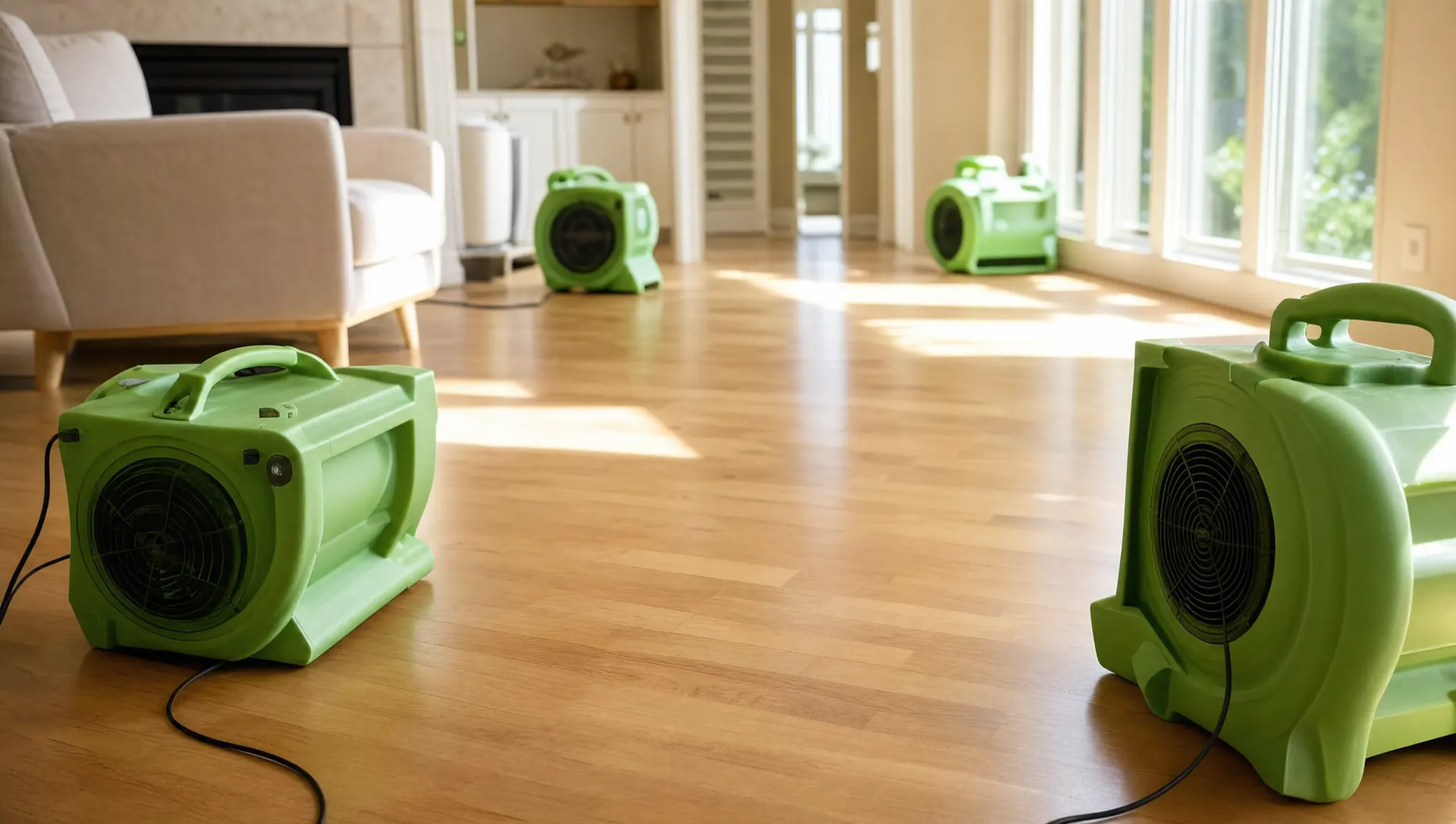
- Air movers. Placed and angled by calculation, not just pointed at the wettest spot, to push air across wet surfaces and speed evaporation
- Dehumidifiers. Commercial units pull moisture out of the air itself, which matters because a room full of humid air can't accept much more moisture from wet materials — without dehumidification, air movers just push damp air around
- Moisture meters. Both surface meters and probes that check moisture content inside materials, not just on top of them
Sized correctly, this equipment can dry a structure in days instead of the weeks it would take relying on open windows and box fans, assuming open windows and box fans could even fully dry it at all, which for anything beyond a small clean-water spill, they typically can't. The sizing matters as much as the equipment itself — too few air movers for the square footage just moves damp air in a circle, and running a dehumidifier that's undersized for the space means it never gets ahead of the moisture load coming off wet materials.
How We Know When It's Actually Dry
This is the part that's easy to fake and easy to get wrong. Dry isn't a feeling or a smell, it's a number. Materials have a documented dry standard, and moisture meter readings get compared against that standard before equipment comes out. A wall that feels dry to the touch can still be holding moisture well above that standard several inches up from the floor.
We take and log readings throughout the drying process, not just at the start and end, so we can see the material actually trending toward dry rather than assuming it's working. If readings stall, that usually means airflow or dehumidification needs to be adjusted, not that it's time to call it done and hope.
How Long Drying Takes
Most residential drying jobs run three to five days of continuous equipment operation. Denser materials take longer — hardwood, plaster, and masonry hold and release moisture more slowly than drywall and modern flooring, which is part of why older homes in Joplin's mining-era neighborhoods sometimes need extra time compared to newer construction with modern materials. Humidity matters too: a muggy stretch of southwest Missouri weather makes the air itself less able to accept moisture, which can stretch out drying time compared to a cool, dry spell.
What Happens When Drying Gets Cut Short
Pulling equipment early is one of the most common ways a manageable water loss turns into a bigger problem later. A room can look and feel dry within a day or two of running fans, while the framing behind the drywall or the subfloor under the flooring is still holding real moisture. Cutting the job short there doesn't save time, it just moves the problem out of sight.
What typically shows up weeks or months later: a musty smell that wasn't there before, drywall that develops soft spots or staining near the base of a wall, hardwood that slowly cups even though nobody remembers a new water event, or a mold finding during an unrelated inspection, like a home sale. Each of those is usually cheaper to prevent with a few extra days of equipment time than to fix afterward, since by that point the fix often involves opening a wall or replacing flooring instead of simply running a dehumidifier a while longer.
This is also why documentation matters during drying, not just at the end. Logged readings showing a room actually reached dry standard are useful later if a moisture problem turns up and someone wants to know whether it's new or left over from an old loss.
Cost of Extraction and Drying
When extraction and drying are the main scope of work, without significant material removal or repair, costs typically run toward the lower end of the general water damage range, since you're paying primarily for equipment time and labor rather than demolition and rebuild. Larger areas, denser materials, and longer-standing water all push the number up, since they mean more equipment running for more days. We'll walk the affected area and give you real numbers rather than a rough guess.
Get the Water Out
The longer water and moisture sit in a structure, the more it costs to fix later. Tell us what you're dealing with and we'll get extraction and drying equipment moving to your property anywhere in the Joplin area.
Need Help in Joplin Right Now?
Tell us what you need and we'll get back to you fast with a free, no-pressure quote.